About this episode
MENTIONED IN THIS EPISODE
Check out our sponsors and resources: Visit Our Sponsor Page
Transcript~64 min read
Somewhere in the last few years, a lot of us started asking a version of the same question: who am I now, and what am I actually here to do? The answers don’t come from a quiz or a vision board. But they just might come from the one word that has been running your life all along, whether you knew it or not.
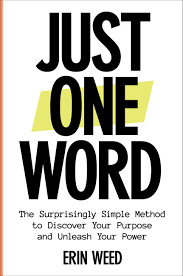
Erin Weed is a speaker coach, keynote speaker, and the creator of the Dig, a purpose-excavation method she has used with over a thousand leaders, founders, and changemakers across every stage of life and reinvention. Her new book, Just One Word: The Surprisingly Simple Method to Discover Your Purpose and Unleash Your Power, is the culmination of that work. She also spent over a decade as head speaker coach for TEDxBoulder, helping people find the one true thing they need to say and the courage to say it.
In this conversation, you get to watch the Dig happen in real time, because Jonathan sits down in the chair and lets Erin guide him through the full process.
What you will explore:
- What the Dig is and why close to 100% of people who think they know their word are actually wrong
- How your life story, all of it, from childhood to present day, contains a 10-word operating system that explains exactly how you tick
- Why your deepest violations, the things that make you genuinely angry, point directly toward your core word
- The difference between the word you think defines you and the one that actually does
- How knowing your word changes the way you make decisions, support the people you love, and build the things that matter most to you
- What Jonathan’s word turned out to be, and the moment in the conversation where it landed
If you have ever felt like you were circling your purpose without quite landing on it, this conversation is for you.
You can find Erin at: Website | Instagram | Episode Transcript
Next week, we’re sharing our conversation with Dr. Lucy Hone to talk about something most of us are carrying without ever calling it what it is: the grief that comes without a funeral, the losses that do not count as real loss in our culture but may be driving more of our suffering than we know. Be sure to follow Good Life Project wherever you get your podcasts so you don’t miss any upcoming episodes!
Check out our offerings & partners:
- Join My New Writing Project: Awake at the Wheel
- Visit Our Sponsor Page For Great Resources & Discount Codes
photo credit: LoveJoy Photography (Ashlee Burke)
_____________________________________________________________________________________________________
Episode Transcript:
Erin Weed: [00:00:00] The Dig is a method to unearth that one word that is your entire purpose, and I think of as a frequency. It’s not so much of a descriptor word. It’s more about a feeling, a way that we carry ourselves through the world. And also the thing that we’re here to learn, and also the thing we’re here to teach. Usually people don’t like their words. Usually they like when it starts to land, it’s like, ooh. It’s almost like it hits a little too close. So that’s kind of part of the process.
Jonathan Fields: [00:00:27] So there’s a version of you that you already know is real. You can feel it, you know, the way you want to spend your time, the, the kinds of problems that let you up, the moments when you look back and think, that was really me at my truest and yet. And yet most of us spend years, sometimes decades, circling that person without being able to live that life, that truest self life, let alone even name what’s at the center of it. Well, what if you could distill that essence, your essence, into a single word that became kind of like the unlock key for your most authentic, real self in all parts of life. That’s the provocative claim that today’s guest is making, and she’s backing it up with a process she has developed. She calls The Dig that she has conducted over many years, with over a thousand people to help them figure out their defining word and then build everything from their business to careers and relationships around it. And what really surprised me, she shared that, let me do that. And what really surprised me is also a second statement that she shared with me that 100% of people who come into this process thinking they already know their word, they’re wrong every single time. In her experience, the real world, the real word, it lives kind of like one layer deeper. Erin Weed is a speaker, coach, and keynote speaker. She’s a creator of something she calls The Dig, which is this provocative kind of purpose excavation method that she has spent 13 years refining with founders and leaders and change makers across every stage of life. She has spent over a decade as a head speaker coach for TEDx Boulder, helping people distill enormous messages down to the single truest thing that they had to say. And her new book, Just One Word The surprisingly Simple method to discover your purpose and unleash your Power, walks you through the same process that she used in this conversation. But this conversation, today’s episode is very, very different because in this episode, Erin ran the full dig on me live from the beginning of my life story to the moment that my word landed towards the end of our conversation. You’ll hear how themes surface, how clusters form, and what it feels like when when one word that has been kind of running in the background for your entire life. Finally has a name. By the end of this hour, you’ll have a clear picture of how to do this yourself, and you’ll know what to look for in your own story. I’m Jonathan Fields and this is Good Life Project. And the place I want to start with, Erin, is the very beginning of how this method came to be. And if you’re wondering what my word is, by the way, stay tuned. We’ll jump in there right after this short break.
Jonathan Fields: [00:03:25] So I am excited to dive into this thing that you call The Dig. Um, you and I have been talking about this for years. We go way back and I’ve heard you’ve created this. You have done it with everyone from founders to neighbors to celebrities. And it’s this process which has been just like, profoundly revealing. So, and it’s now sort of like the focus of your new book. Just one word. So what is The Dig?
Erin Weed: [00:03:57] The Dig is a method to unearth that one word that is your entire purpose. And I think that’s incredibly important because in a world that is just so busy and overwhelming and we’re always seeking. It’s just so nice to be able to land on that one word, which I really think of as a frequency. It’s not so much of a descriptor word. It’s more about a feeling, a way that we carry ourselves through the world, and also the thing that we’re here to learn, and also the thing we’re here to teach.
Jonathan Fields: [00:04:23] So the idea is you distill it down to a single word we do.
Erin Weed: [00:04:27] And the way we do it is we go backwards in order to go forwards. So we look in your history to figure out your future.
Jonathan Fields: [00:04:34] Okay, I’m going to ask you a lot more about the process in a moment. But um, why do we care? Like, why does it matter that we actually know this?
Erin Weed: [00:04:42] I think purpose is incredibly important. And all the research shows that purpose is just a thing that affects your mental health. It affects your quality of life. It affects everything. And when we know that one word, we can start aligning with our purpose, we can align our actions. We can align our decisions. We can align our messages. So knowing that one word is I see it as like a it’s almost like a North star. It’s something to guide us.
Jonathan Fields: [00:05:04] What happens if you don’t know it?
Erin Weed: [00:05:06] What happens if we don’t know it? What a good question. Well, I think you still can live a great life, for starters. I just feel like it’s a tool. It’s just an extra tool to give us more clarity. Because I find that when you’re more clear that you can feel more confident about the life you live. When you feel more confident, you can start connecting with more people and be more connected to yourself.
Jonathan Fields: [00:05:24] Okay, so you have been developing this process for how long?
Erin Weed: [00:05:31] 13 years. Yeah.
Jonathan Fields: [00:05:33] What was the origin of it?
Erin Weed: [00:05:35] Actually, the origin was actually TEDx Boulder. And, uh, previously I was a professional speaker. I owned a company called Girls Fightback, which taught women safety and self-defense classes at high schools and colleges across the world. There were more like big seminars and assemblies. And after I sold that company, I started working with TEDx Boulder to coach their speakers. And what I found was that people were so overwhelmed by these big messages they had. They had so much data, so many ideas. They were having a really difficult time distilling it all down. And so I would basically just tell people, tell me everything. And before long, I would just be sticky, noting the wall would be completely covered. And what I was looking for was those one word themes. How does this all tie together? And so once I found these one word themes, I ultimately distilled it down to just one word for the entire message. And once the person got to it, they were like, yes, that’s me. And then surprise, surprise, those ended up being viral Ted talks because they felt so clear and confident in what they were putting out to the world.
Jonathan Fields: [00:06:32] So, I mean, it sounds like it’s important, not just because it tells us more about who we are and kind of like why we’re here to a certain extent, but also in terms of communicating that to the world. It sounds like then you can use it as a foundation to really figure out like, what is the story that I’m telling? And that’s whether it’s a personal relationship, a job like whatever it is in your life.
Erin Weed: [00:06:55] Yeah. I mean, I love a good navel gaze and just like doing the deep personal development work, we both have that in common. And there’s something so incredibly cathartic, but also an act of service to also share what we discover with the world. And so for me, it feels a little incomplete to just find your word. I also want people to like write about it, talk about it, share about it, build a business around it, build a brand around it.
Jonathan Fields: [00:07:17] Let’s talk process. How does this actually work?
Erin Weed: [00:07:21] The process is very simple. All you have to do is show up and be you and tell me your whole life story. And how many times has somebody said.
Jonathan Fields: [00:07:26] Oh, that sounds easy?
Erin Weed: [00:07:28] I mean, I hate to steal your job and everything.
Jonathan Fields: [00:07:30] it takes like a week.
Erin Weed: [00:07:32] Surprisingly, I found that the average person’s life story, when given no prompt to end, is about 90 minutes.
Jonathan Fields: [00:07:39] Mhm.
Erin Weed: [00:07:40] People talk for about an hour and a half about their life story. And then at that point, they usually feel about complete. And so in that life story, I look for these one word themes that keep coming up. When you’re a child, when you’re a young adult, when you’re all the way up to present day. And as I find these one word themes, they all come together to be an operating system, ten words or less. That operating system is exactly how you tick. It is your operating manual for yourself. It’s also your core message. If you’re a person who is a speaker and author. And so within this operating system, there’s one word that’s in charge. So if you think of the operating system like a sports team, a view, The Dig word is the captain.
Jonathan Fields: [00:08:19] As long as we’ve known each other, we have never sat down. And actually, I don’t know my word. Yeah.
Erin Weed: [00:08:27] Well, maybe we should figure it out.
Jonathan Fields: [00:08:29] I’m gay.
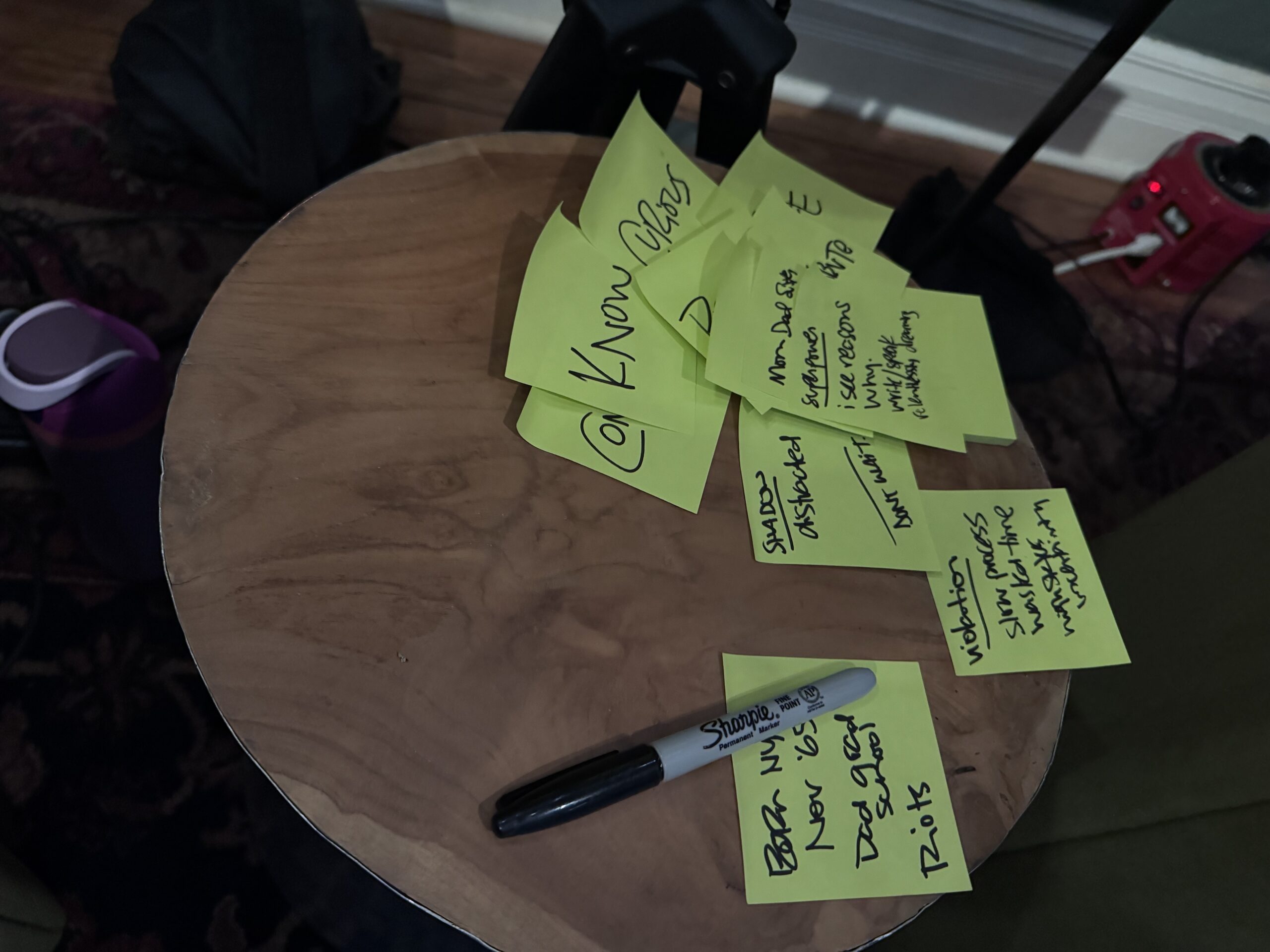
Erin Weed: [00:08:30] You’re down. Yeah. Okay. Well, you know, I never leave the house without sticky notes and a Sharpie, so here we are.
Jonathan Fields: [00:08:37] Okay,
Erin Weed: [00:08:38] Okay.
Jonathan Fields: [00:08:38] I’m nervous.
Erin Weed: [00:08:39] So Jonathan Fields is letting me interview him. So, like, let’s just, like, allow that in for a moment. Well, first of all, thank you. Um, I always like to thank people that sit down in these chairs and are willing to share because that’s. I just see it as a very sacred thing, you know, to share your past. And, um, could we begin from the beginning?
Jonathan Fields: [00:09:01] Yeah. I mean, I’m sweating already, so let’s just. Let’s do it.
Erin Weed: [00:09:05] Well, I’m actually curious, like, what is, what is the source of tension for you? Like in this moment?
Jonathan Fields: [00:09:09] Um, I don’t know where we’re going to go.
Erin Weed: [00:09:11] Okay. Do you have a word in mind? Like, do you feel like I know my word?
Jonathan Fields: [00:09:16] I feel like I probably do.
Erin Weed: [00:09:19] Interesting.
Jonathan Fields: [00:09:21] Um, but I kind of don’t want to say it because I want to just see where this takes us.
Erin Weed: [00:09:25] Okay, well, let’s check in at the end. Okay. I have actually found that a startling 100% of people who thought their word was one thing were wrong.
Jonathan Fields: [00:09:33] Interesting.
Erin Weed: [00:09:34] And I don’t need to be right or anything. It’s so it’s not about that, but it’s just usually someone’s big word is actually on the other side of the word that they actually thought it was. It’s like just the one layer deeper. And that is the magic.
Jonathan Fields: [00:09:48] Okay.
Erin Weed: [00:09:48] Yeah.
Jonathan Fields: [00:09:49] Okay. I’ll keep it in the back of my mind.
Erin Weed: [00:09:51] Okay. Sound good?
Jonathan Fields: [00:09:52] And suspend judgment.
Erin Weed: [00:09:53] Yeah. Sound good? Sounds good. Um. Okay. Well, I’m going to be sticky noting. I’m just going to be writing things down. Um, um, I’m going to be putting up some words that start popping up as we go along, so don’t be distracted by them. And, um, maybe even everybody who’s listening or watching can be kind of thinking of words too.
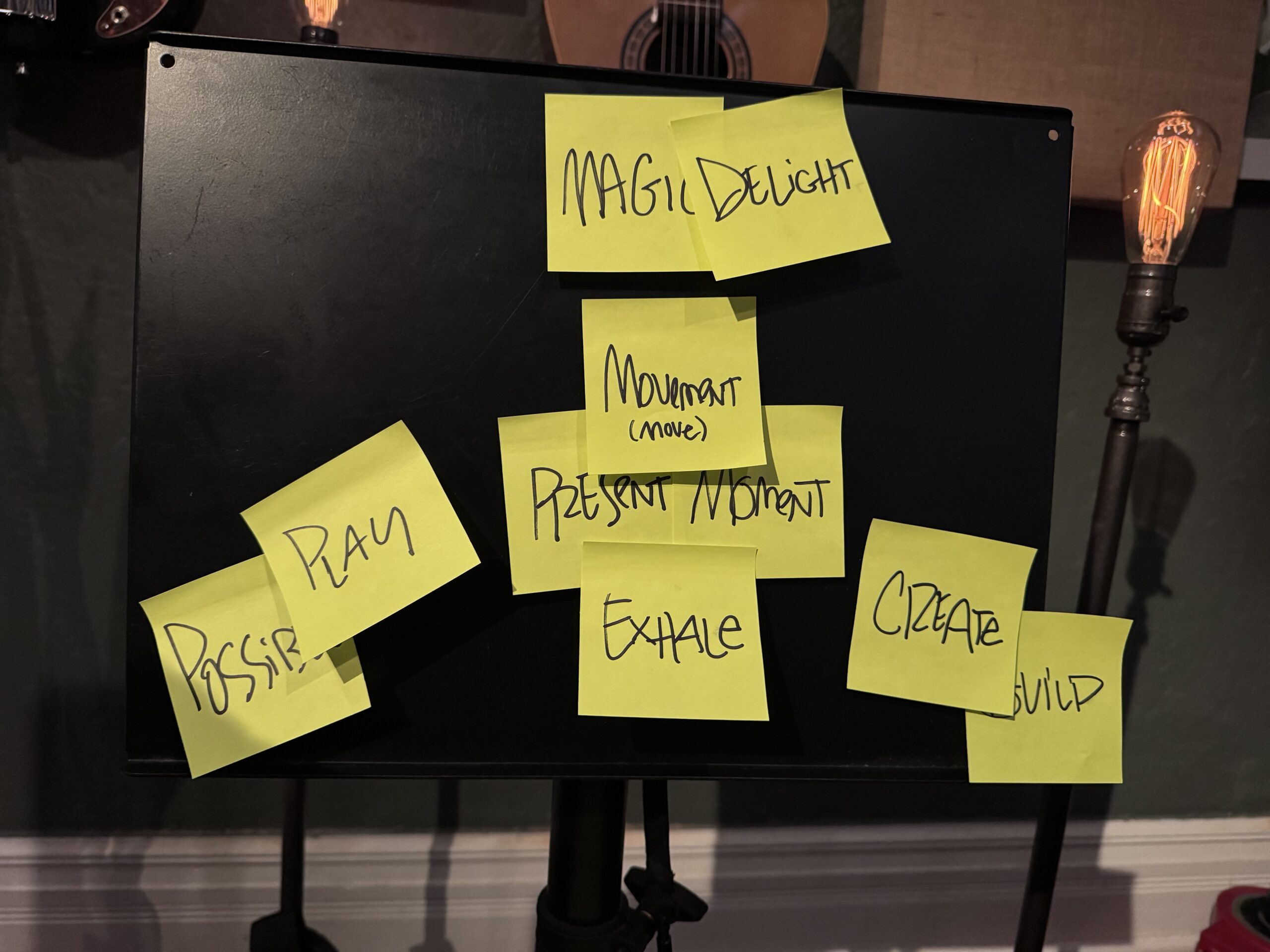
Jonathan Fields: [00:10:11] Yeah. Sounds good. All right. By the way, um, for anyone who is listening and not watching, um, if Erin puts up sticky notes or anything like that that she references, we will take a couple of screenshots and, um, and, and create a little link that we can point you to so you can see whatever it is that we’re talking about.
Erin Weed: [00:10:29] Yeah. And I’ll also say them out loud too.
Jonathan Fields: [00:10:31] Cool.
Erin Weed: [00:10:31] All right. Great. So we begin at the beginning.
Jonathan Fields: [00:10:34] Okay.
Erin Weed: [00:10:35] What’s your birthday and where were you born?
Jonathan Fields: [00:10:37] Um, so born in New York City, um, in November 1965.
Erin Weed: [00:10:45] Mhm. What was your family like?
Jonathan Fields: [00:10:47] Um, mom and dad, older sister by two years and extent that I can really remember anything from that long ago, just very neighborhoody.
Erin Weed: [00:10:57] Like what would be the words you’d use to describe it?
Jonathan Fields: [00:10:59] Close knit. Um, I feel like we knew our neighbors in the building.
Erin Weed: [00:11:03] Yeah. How do you think people would describe you growing up?
Jonathan Fields: [00:11:05] Always creative.
Erin Weed: [00:11:06] Let’s fast forward a bit. So you grow up. Did you stay in that same place?
Jonathan Fields: [00:11:10] No. We ended up moving out to Long Island and eventually to Port Washington, which is the town. Actually, that was the real, um, East Egg from The Great Gatsby. It’s actually based on a real town, really. A little peninsula, egg shaped peninsula on Long Island on the water. So I grew up basically in a in a small town just outside of New York.
Erin Weed: [00:11:30] How did that shift your life?
Jonathan Fields: [00:11:32] Um, I mean, I loved it.
Erin Weed: [00:11:35] Mhm.
Jonathan Fields: [00:11:35] I love water, um, which is one of my biggest sadnesses. Like, I don’t have a lot of sadnesses, but like living in Colorado.
Erin Weed: [00:11:42] Yeah. Not gettin’ that.
Jonathan Fields: [00:11:43] Um, not being near large bodies of water, I feel it. The end of my block was a bay, and I would just ride my bike down there and kind of climb up on top of the lifeguard’s house and sit. Um, that was my place.
Erin Weed: [00:11:56] What does what does water do for you?
Jonathan Fields: [00:11:59] It lets me just lets my whole body exhale, my mind exhale also.
Erin Weed: [00:12:05] Yeah.
Jonathan Fields: [00:12:05] It’s like makes everything as okay as it can be.
Erin Weed: [00:12:08] Mhm. Do you find that you tend to hold your inhales a lot? And so that it’s a good reminder to complete the process?
Jonathan Fields: [00:12:16] I think there are times in my life that I did. I don’t feel like that’s me now.
Erin Weed: [00:12:20] Yeah. Does exhale to you mean like release?
Jonathan Fields: [00:12:23] Yeah. It’s like my whole nervous system down regulates.
Erin Weed: [00:12:26] Okay.
Jonathan Fields: [00:12:27] Yeah. Like my heart rate slows, my mind stills, my body relaxes.
Erin Weed: [00:12:31] Mhm. What did you want to be when you want when you grew up?
Jonathan Fields: [00:12:35] Um, when I was younger. I wanted to be an architect, actually.
Erin Weed: [00:12:39] Mhm.
Jonathan Fields: [00:12:40] Um, and yeah, I just always had this impulse to build stuff.
Erin Weed: [00:12:45] Mhm.
Jonathan Fields: [00:12:46] So the idea of building cool structures.
Erin Weed: [00:12:48] Mhm.
Jonathan Fields: [00:12:49] Was something that, um, I thought was really cool.
Erin Weed: [00:12:53] Mhm. Are there certain kind of structures that you were pulled to?
Erin Weed: [00:12:56] Houses.
Jonathan Fields: [00:12:57] Yeah.
Jonathan Fields: [00:12:58] Yeah. Just like really cool houses.
Erin Weed: [00:13:00] What about houses versus like, big skyscrapers or something?
Jonathan Fields: [00:13:03] Um. I don’t know. There’s something kind of, uh. Cool about, I think just the scale of a house. And also, I think I associated skyscrapers with being sort of industrial monolithic, whereas like in a home, you could get really creative and also talk to like one person or two people and really figure out like, what can we make that’ll just make their eyes pop and make them walk into it and have the same feeling that I had when I was by water.
Erin Weed: [00:13:32] Yeah. What is that feeling? If you had to put it in one word. That eyes pop.
Jonathan Fields: [00:13:37] Delight.
Erin Weed: [00:13:38] Delight. Mhm. What does that word mean to you?
Jonathan Fields: [00:13:41] It means that you are surprised in a way that makes your entire system light up.
Erin Weed: [00:13:50] That is a great word.
Jonathan Fields: [00:13:51] It’s a good word.
Erin Weed: [00:13:52] Yeah.
Jonathan Fields: [00:13:53] Yeah.
Erin Weed: [00:13:53] Like, I feel, like.
Jonathan Fields: [00:13:54] Stephanie is sort of like the queen of that.
Erin Weed: [00:13:56] Yeah.
Jonathan Fields: [00:13:56] For those who don’t know, Stephanie’s my wife. She is.
Erin Weed: [00:13:58] She’s amazing.
Jonathan Fields: [00:13:59] Absolutely amazing at creating experiences of delight.
Erin Weed: [00:14:02] Mhm. Okay.
Jonathan Fields: [00:14:05] And we’ll be right back after a word from our sponsors.
Erin Weed: [00:14:10] So keep us going through your timeline here.
Jonathan Fields: [00:14:13] Yeah. Um, so that was me like teens. Um. Probably spend a lot of time exploring art when I was a kid also.
Erin Weed: [00:14:27] Mhm.
Jonathan Fields: [00:14:28] Um, I was always doing something with my hands. I was always making stuff with my hands. Building stuff, drawing stuff, painting, um, taught myself to paint when I was middle school or high school.
Erin Weed: [00:14:39] Mhm.
Jonathan Fields: [00:14:40] And, um, just painted on a really regular basis. My mom was also a potter when I was a kid. So the basement of our house was a studio, you know, with like three electric wheels and massive old kick wheel with like a £200 concrete flywheel in the corner.
Erin Weed: [00:14:55] Mhm.
Jonathan Fields: [00:14:55] Kilns off property. She had, like, a giant, literally walk in gas fired kiln that would take a day to fire. Um, so I was around that energy all the time. Um, and I grabbed the corner of that studio and just set up my own little, little mini improvised painting studio, and I would just completely lose myself there.
Erin Weed: [00:15:16] What is your criteria for making, building, creating? What does it have to be? Like do you have. When you set out to make, build or create. Is there something you’re striving for?
Jonathan Fields: [00:15:27] Um. Uh, honestly, I think it’s less about being, being, being able to say that I’ve done the thing and it’s more about doing the thing.
Erin Weed: [00:15:38] Mhm. So it’s the process versus the result.
Jonathan Fields: [00:15:40] 100%. You know, I get like, I mean, like later in life, I’ve written a whole bunch of books and I’ll get the box of books in the mail from the publisher. Um, as you may have gotten recently yourself and I would just let it sit for weeks and Stephanie was like, what’s wrong with you? Like, like you just got the book. Like it’s here. It’s hardcover. It’s like, don’t you want to see it? I’m like, yeah, sure. Um, for me, it was a process of creating it that was like where the magic was. And it’s pretty much always, I mean, am I proud of the things that I’ve created? When I can look back and say, I’ve been able to come close to closing the gap between taste and expression? Yeah, that makes me proud. But at the end of the day, it’s not why I do it. That’s just a signal that like, I’m getting closer to actually doing what I came to do.
Erin Weed: [00:16:23] Okay. So what did you end up going to college for?
Jonathan Fields: [00:16:28] Uh. Screwing around, majored in, uh, not attending classes. I was a horrible student, but I was building stuff from the day that I was there. I started a business sound lighting, mobile disc jockey, and we grew it into like one of the business businesses that was really sort of like the main player in that field, like at all the parties, all the concerts and building that business, and then being out and deejaying at clubs until 3 or 4 in the morning was most of my life. In college, we had massive speaker stacks and equipment in like the house that I lived in, and I would just play with it all day long and then go out and get paid to play with it all night long. Which led me to my senior year where I didn’t have enough credits to graduate. So I had to take 21 credits a semester. Oh, and begged my way into a one credit class on earthquakes just to be able to get out. But I was building like I was in that case. And like, music has been a persistent passion of mine also from the earliest days. I played guitar really horribly for most of my life. Um, but I just love any kind of good music.
Erin Weed: [00:17:44] And you’ve even made guitars, right?
Jonathan Fields: [00:17:46] I have, yeah.
Erin Weed: [00:17:47] Okay.
Jonathan Fields: [00:17:48] Yeah.
Erin Weed: [00:17:49] All right. So it feels like a lot of the words that you’re talking about, they’re very like in the moment. Like, have you ever struggled in your life of just like not being in the moment.
Jonathan Fields: [00:18:00] Constantly.
Erin Weed: [00:18:01] Anxiety or just future thinking past stuff?
Jonathan Fields: [00:18:04] Yeah. Less anxiety, but constantly future thinking.
Erin Weed: [00:18:07] Okay.
Jonathan Fields: [00:18:07] I am, I am perpetually living in the future.
Erin Weed: [00:18:11] Mhm.
Jonathan Fields: [00:18:12] Not in a bad way. Like I’m not spinning or fretting about it. I’m not, I’m not weirdly wired, not so much in a doom and gloom way, but more in a possibility way.
Erin Weed: [00:18:20] Okay.
Jonathan Fields: [00:18:21] So like, I live there because I’m constantly, I’m constantly exploring what I think is going to be coming and seeing like how I might be able to play with that, to leverage it, to turn it into something. And to be to a certain extent, ahead of the curve. And that has led me a number of times, actually, to be too far ahead of the curve where I would bring something to life that was a little bit before its time.
Erin Weed: [00:18:47] Can you give me an example of that?
Jonathan Fields: [00:18:48] I mean, you could argue, actually, that the yoga business that we created in New York City was a bit ahead of its time. Um, we were trying to I launched yoga studio literally on the eve of nine over 11 in New York City. Um, and, but the ultimate goal was to build the first ever national, um, roll up business franchise that was national chain.
Erin Weed: [00:19:11] Okay.
Jonathan Fields: [00:19:11] Um, and probably I, I came to realize that it wasn’t necessarily a business that I wanted to be, and it wasn’t a business that I wanted to build. Um, somebody else did. And, um, but they did it differently. And it was a couple of years before yoga hit, sort of like a level of mass appeal and understanding and was embraced on a level where you didn’t really have to convince people that there was something interesting here. You basically just had to open it where it didn’t exist. And, um, so it was a different experience for me. Um, I mean, I ended up selling that business seven years later. Um, but yeah, and there just probably a whole bunch of ideas that I’ve had over time where it’s sort of like world wasn’t quite ready.
Erin Weed: [00:20:02] Okay. But you didn’t start off with this yoga studios, right? You had a bit of a life before that. Can you bring me?
Jonathan Fields: [00:20:08] Um, yeah. So after college, um, sold the business and then I went back to law school. Um, not necessarily because I had an interest in being a lawyer. Um, but because I had screwed off so much in college that I was just really curious what I was truly intellectually capable of. I want to challenge myself and I want to challenge myself in a way where I thought whether I actually practiced or not, it would give me a set of skills that would be relevant to almost anything that I did. Mhm. So I sold my car, did all the other things, moved into the city, and spent three years in law school. And thankfully, um, I was the kid who basically showed up and said, like, I’m here with a mission. Um, I wasn’t there to just delay my life for three years, which a lot of people do with grad school. I was there because I wanted to actually challenge and see what I was capable of doing. I got really fortunate. I worked really hard, and I graduated with a lot of, um, credibility in my class and ended up then working for the federal government for three years, the SEC. I also working in a massive federal bureaucracy with just crazy politics and crazy inefficiency. As somebody who likes to just get things done. It was maddening. So I left and I went into a mega firm in New York.
Jonathan Fields: [00:21:38] Then switching sides. Incredible firm. All the prestige you could ever want. Like the track that everybody would want coming out of law school. Incredible salary for somebody who didn’t know what he was doing. And I showed that every day that I was there. Um, and I ended up in the hospital, um, because we were on a deal where, um, basically I barely went home for three weeks and my immune system shut down. A huge infection, blossomed in the middle of my body and ate a hole through my intestines from the outside in. So, um, yeah, hit the button on the deal, ignored the pain because that’s what we do. And then, um, pretty much went straight to the hospital. Thankfully, surgery was successful. Um, but it really made me rethink. What am I doing with this one wild and precious life, as Mary Oliver would say. And it was clear that it wasn’t going to be that. Um, and that sent me slowly back into the world of entrepreneurship. And at that point, um, movement and fitness, because I’ve always had a deep connection to just sort of like somatic expression to the connection between mind and body. And I wanted to learn that industry. I wanted to understand what was working and what wasn’t working.
Erin Weed: [00:22:53] Mhm.
Jonathan Fields: [00:22:54] So I talked my way into a job as a personal trainer making $12 an hour, which I was okay with because I was getting paid something just to learn an entirely new industry.
Erin Weed: [00:23:07] After like that career. That had to be a wild experience.
Jonathan Fields: [00:23:11] Yeah. My biggest fear was that like, one of my clients or colleagues from Law Review and law school would like see me with a client, like stretching them out, like, you know, on the grass in Central Park wearing tights and running shoes in the middle of the day and be like, oh, what a shame. Like What a fall from grace.
Erin Weed: [00:23:31] Mhm.
Jonathan Fields: [00:23:32] Um, but very quickly, I ended up building my own business. And within a couple of years, like those very people that whose judgment I was concerned about were the ones who were reaching out to me to find out how I did what I did.
Erin Weed: [00:23:46] Mhm. So what do you think you figured out that other people didn’t.
Jonathan Fields: [00:23:50] That everything’s figureoutable. It’s like that. There’s. I see, like, I’m weirdly wired in that I wake up in the morning and I see possibility.
Erin Weed: [00:23:58] Yeah.
Jonathan Fields: [00:23:58] You know, like, people see obstacles. People see reasons why not. And I see reasons why. Um, and if, you know, if almost nobody is doing it, and most people assume that’s because it’s not doable, I look for the 1 or 2 who are as proof that it is possible and ask like, what’s my contribution? What’s my flavor? That’s not being done. Um, and it, yeah, I’m weirdly wired for possibility. I don’t. Yeah.
Erin Weed: [00:24:31] So that wasn’t something that you just decided positive thinking.
Jonathan Fields: [00:24:34] No. No.
Erin Weed: [00:24:36] To talk yourself into it.
Jonathan Fields: [00:24:37] No. I mean, I’ve been I’ve been around a lot of anxiety my whole life.
Erin Weed: [00:24:43] Mhm.
Jonathan Fields: [00:24:43] Um, it’s it doesn’t. It’s not my default.
Erin Weed: [00:24:49] Yeah.
Jonathan Fields: [00:24:49] My, my default is really looking at uncertainty. I feel very uncomfortable with high stakes uncertainty. It affects me physically and psychologically, which is why I’ve studied a lot and built practices to be okay doing it. Because I know I have to be in that space to do the thing I’m here to do, like live in a place of possibility, is also to live in a place of uncertainty.
Erin Weed: [00:25:11] Yeah.
Jonathan Fields: [00:25:12] You know, there’s, there’s no separating the two. And so, but, but being in that space is really deeply unsettling for most people, including me.
Erin Weed: [00:25:21] Yeah.
Jonathan Fields: [00:25:22] Especially as the stakes rise. Um, so I’ve had to, to learn how to be okay there.
Erin Weed: [00:25:27] What advice do you give people who are wildly uncomfortable with it?
Jonathan Fields: [00:25:34] People tend to have three reactions to it. One, as soon as they feel it, they’ll either speed forward to try and get through whatever the moment is as quickly as possible, so they can just stop feeling it. They’ll backpedal to pull themselves out of it enough so that they stop feeling it, or they’ll sit in stasis. They’ll become paralyzed. Um, they just don’t know what to do. And they’re afraid to go back. They’re afraid to move forward. So they just sit and suffer. In my experience, that’s probably most people. And they don’t realize that’s actually what’s happening. And to me, it’s like one approach to Buddhism or one of the sort of core teachings is that life is suffering. And I always struggle with that. Um, the way that my mind has come to interpret it is that, um, life is uncertain. That is the only certain thing in life is that it is and will be perpetually uncertain. And a life where you allocate the vast majority of your waking hours to trying to lock down the future, to trying to make it certain. Which is what almost all of us do that is suffering. It will always be suffering because it is impossible to do or to have. So to me, I’ve stopped trying to do that. I’ve stopped trying to make life as certain as possible, and I’ve started to equip myself with the practices and skills to let me be as okay as I can in the space of uncertainty, as stakes rise. That doesn’t mean I always am. But, um, that’s my, that’s the shift in approach that I’ve taken. And again, because the other truth is that, like I said before, um, uncertainty and possibility, two sides of the same coin. So if I’m here, like, if I just want to walk through the world and say yes to possibility, then I have to say yes to uncertainty at the same time. Like I can’t. I can’t just choose one or the other. So I have to teach myself how to be okay with it.
Erin Weed: [00:27:31] It’s a big work.
Jonathan Fields: [00:27:33] Yeah, it’s. And it’s a work that never ends. It’s not like, check the box and you’re good. Yeah, it’s a practice.
Erin Weed: [00:27:39] Yeah.
Jonathan Fields: [00:27:40] And as the stakes rise and change and you get brought to your knees again, it’s another practice.
Erin Weed: [00:27:45] Yeah. Take me into podcasting and books and that whole area of your life.
Jonathan Fields: [00:27:51] So I was, um, running a yoga studio in New York City. We were about six years in, um, all the highs and lows of running a business in New York. Um, with the physical location, we were renting a floor in a building, um, the six year lease and a personal guarantee and um, yeah, signed the day before nine over 11 and um, yeah, it was, it was, there were high highs. I mean, the business was doing pretty well, but there were low lows and just profound uncertainty. And I also had developed a real interest in writing and creating in a different way. Um, I mean, it’s magical when you walk into a yoga studio and you’re the teacher and, you know, there are 50 bodies mat to mat and it’s sweaty and for 90 minutes you create this sort of like ecstatic, ecstatic synchronicity between everybody and like their movement and their breath. And you can, like, bring them down to Shavasana at the end and you feel everybody, the whole room exhale and you’re just like, fuck, yes. It is magical to to know that you’ve played even like some role in helping make an experience like that happen. And I loved it. And years of that, um, wore on me. Years of running the business, um, at the same time and supporting it, especially because married and we had a three month old baby when we started that business. So it was a lot. Um, so, and I had developed an interest in writing and I’d been doing a bunch of writing, um, on the marketing side of things, Deep interest in just human psychology. What moves people to action? How do I motivate a lot of people to actually have that same bent towards possibility and then take action towards it? This to me is what marketing is. You know, um, and I just got really curious in like, um, why people don’t take more control over the future of their work lives.
Erin Weed: [00:29:45] Mhm.
Jonathan Fields: [00:29:45] Um, that led me to get curious about writing a book about it. And I got really fortunate and then got an agent from a big publisher. Um, and I got an agent out of the gate who took me cold and then got a deal. And that started my writing career. And once that was begun, I actually, it was right around the time that Tim Ferriss had just come out with four hour workweek. I literally called him and got him on the phone and I was like, so what? Like, how do you do? How do you like make books sell now? And he’s basically, he’s like, like back then it was blogs, like blogs and like getting on a plane and talking to people at events. Um, so I just started shifting gears into the online world and that led me into this whole new world of like digital, like it wasn’t called being creator back then. Um, you know, this was a blogger and then it was digital content and then it was social media and this was, you know, the days when you’re at South by Southwest in 2007 or 2008, and Twitter has, you know, like it’s itty bitty and it’s crashing every three seconds because the servers can’t hold. And it’s and that just over time, um, led me to want to devote more time and energy to that world and to write more and to speak more. And that sort of like was my, my introduction to that whole space. Um, and then, uh, yeah, so sold the book. Um, the first book came out in January of 2009. I sold the studio at, towards the end of that of 2008, handed over the keys December 31st, walked out the door, taught my last class. Most people did not know it was my last class until I brought them up from Shavasana, which is final relaxation for anyone who’s never taken a class and said, hey, listen, um, there’s something I need to share with you.
Erin Weed: [00:31:32] Wow.
Jonathan Fields: [00:31:33] And that was emotional.
Erin Weed: [00:31:34] Yeah.
Jonathan Fields: [00:31:35] Um, but it felt right too. Like there was no looking back. I had done what I came to do.
Erin Weed: [00:31:41] Yeah.
Jonathan Fields: [00:31:42] And that moved me into this world that I’ve been in for a long time, since 2012. We started Good Life Project the podcast. 14 years later, it’s become what it is now, which had you asked me back then, I would have laughed out loud. I was like, there’s no there’s no way, there’s no way it’s going to become the size and reach so many people and be. There’s no conceivable way I would be doing anything for 14 years.
Erin Weed: [00:32:05] Yeah. What do you think the secret sauce is of Good Life Project?
Jonathan Fields: [00:32:08] Um. I don’t know. I think we started at a time where it was not nearly as crowded as it is now and then if you just never stopped. Um, which we didn’t, you know, eventually you just slowly grow and slowly grow. Slowly grow. There was no like magic, like hockey stick moment with us. It’s 14 years of just never stopping. Um, and also continuing to shift and change.
Erin Weed: [00:32:38] Yeah. It’s almost like evolving is kind of in the middle of possibility and uncertainty. It seems like they’re all tied together somehow.
Jonathan Fields: [00:32:47] Yeah,
Erin Weed: [00:32:48] Yeah,
Jonathan Fields: [00:32:49] Yeah.
Erin Weed: [00:32:50] Like holding both the uncertainty and the possibility and like evolving through it. What is some of the best feedback that you’ve gotten from your listeners over the years? Like it’s something that just hits your heart. You’re like, yes, we’re doing it.
Jonathan Fields: [00:33:01] Probably just that something that we put out into the ether made a real difference for them. I mean, there have been like so many versions of that that we created a moment or there was something that was said often. It’s not something I’ve said, but just there was a moment that happened, um, or something that a guest has shared that’s really awakened something in them. Um, that’s made a real difference. Like they’re struggling and it’s really helped them through something. I think that’s, um, when they see themselves in somebody or some moment or some experience, um, the hands down, the thing that we’ve done that has been the most impactful is, um, the adult summer camp that we ran for five years, camp GLP, they came thinking that they were there to learn a whole bunch of things. And what they realized when they got there is they were there to just reconnect with a part of themselves they had left behind decades ago. And we’ll be right back after a word from our sponsors.
Erin Weed: [00:34:01] What’s interesting about you is, I mean, there’s so many interesting things, but like, you are such a logical, deep thinker. You have used the word magic or magical 3 or 4 times. And I’m just curious, what is your definition of magic?
Jonathan Fields: [00:34:15] I think there’s a connection between the whole between magic and possibility. You know, it’s this the belief that it’s it’s tied to like the belief that things that people can’t understand and say are impossible can actually happen.
Erin Weed: [00:34:29] Mhm.
Jonathan Fields: [00:34:30] Um, and that. There are also just things that we can’t often explain, but they are.
Erin Weed: [00:34:40] Yeah.
Jonathan Fields: [00:34:41] You know, there’s been attention my whole adult life, at least where the rational side of my brain is always looking for the explanation for phenomena.
Erin Weed: [00:34:49] Mhm.
Jonathan Fields: [00:34:49] The older I get, the less I feel the need to have that explanation, and the more I just accept the fact that this happened. It is. I have no explanation for it. It feels kind of mystical.
Erin Weed: [00:35:02] Mhm.
Jonathan Fields: [00:35:02] And that’s okay.
Erin Weed: [00:35:03] Yeah. Bring us up to present day.
Jonathan Fields: [00:35:08] So hanging out. Boulder, Colorado was not planned. We didn’t think we were moving. We just thought we were escaping the pandemic. And here we are six years later. Um. Still doing the podcast, um, built and recently sold one other company along the way that was a deep dive into the intersection between meaning and work, um, focusing deeply on really looking back at Good Life Project. right now and reimagining who we are, what we’re about, and super excited about a lot of things that we’re about to give birth to, um, in the next couple of months and years connected with this brand and community. Um, hanging out with friends here who I have probably more friends here in six years than I had in New York City in 30 years, because it’s just a shared value set. And I was also a bit of a weirdo in New York City. You know.
Erin Weed: [00:36:13] The best kind of weirdo.
Jonathan Fields: [00:36:14] Yeah, well but not necessarily. You know, like, there are people follow certain prescribed paths very often. Um, and here everyone’s kind of a weirdo.
Erin Weed: [00:36:22] Mhm. Facts.
Jonathan Fields: [00:36:24] So, um, it kind of makes it easier. Um, and, you know, for 34 years, my wife has been my best friend, um, and for 25 years, like we’ve had the blessing of having like an incredible kid. Um, and there’s really nothing more important to me than those relationships.
Erin Weed: [00:36:51] Yeah. They’re pretty amazing.
Jonathan Fields: [00:36:53] Yeah. They are. Not going to fight you on that.
Erin Weed: [00:36:56] What would, uh, what would they both say are your best superpowers and your biggest shadows?
Jonathan Fields: [00:37:03] Probably that I’m relentlessly possibility. I’m relentlessly oriented towards possibility. I’m a dreamer. I’m not a dreamer who basically just dreams. I’m a dreamer. Also like works really hard to make what I see real. Um, that’s the maker impulse in me. The builder. Like for me, it’s not just about like what’s possible, you know, that’s fun, but the real fun is making it real.
Erin Weed: [00:37:31] Mhm.
Jonathan Fields: [00:37:32] Yeah. It’s not enough to just like, see or dream. To me, that’s a little bit of like wasting time. Like I want to actually make it real.
Erin Weed: [00:37:40] It’s almost like the possibility is the prerequisite for you to be able to make the thing.
Jonathan Fields: [00:37:44] And I think it’s a double edged sword because I see so many things that I can become really distracted.
Erin Weed: [00:37:48] Um.
Jonathan Fields: [00:37:49] And fragment my attention. And that becomes super frustrating for me.
Erin Weed: [00:37:53] Yeah.
Jonathan Fields: [00:37:53] Um, and also I, I may believe things are possible and maybe aren’t really all that possible and allocate energy and resources to it and then realize, hmm, maybe not. So I think it’s like, it’s, it’s, it’s both the plus and the minus.
Erin Weed: [00:38:14] Yeah. Let’s imagine that you’ve lived a long life. You’re 150 years old. You’re on your deathbed. All of your loved ones are around you. And you’re, you have an opportunity to impart your final wisdom. What are you going to say to your loved ones?
Jonathan Fields: [00:38:31] The words that Debbie Millman shared with me like years ago, like, just come right into my head. So these aren’t my words. Um, don’t wait, don’t wait, don’t wait to be the person that you know you are to share the person that you know you are. Don’t wait to do the things that you want to do. Don’t wait to show up in the way that you know makes you feel whole and seen. Yeah. Don’t wait for permission.
Erin Weed: [00:39:02] Interesting. I love that. There’s like an urgency in it.
Jonathan Fields: [00:39:06] There is. And it’s weird because a number of people have brought up at different points in my life. The word urgency, like why are you pushing so hard, so fast? Like, why does this need to happen now? And, um, I don’t know the answer, but I think at least for the second half of my life, I think it’s probably connected to 9/11
Erin Weed: [00:39:29] Yeah.
Jonathan Fields: [00:39:30] Um, because I just like, I saw people go to work that day and not come home and like, you know, these weren’t people who were doing anything dangerous. These weren’t people where you’d be like, oh, well, they chose to do this thing. They’re a rock climber. They’re this or they’re they risky behavior. These are people living everyday lives doing the thing they do. And they went to work in the morning and didn’t come home at night.
Erin Weed: [00:39:51] Mhm.
Jonathan Fields: [00:39:52] Made no promises. And it’s the other thing that’s constantly scrolling in my head. It’s part of the don’t wait thing. Um, so I think there’s a bit of a self-imposed urgency that I have. Yeah. Um, because God willing, I do have a lot of time left, but I generally don’t bank on that.
Erin Weed: [00:40:08] It’s a good way to move through the world, right? Especially when you have like uncertainty as a theme that comes up in your life.
Erin Weed: [00:40:14] Yeah. I mean, you know, this viscerally.
Erin Weed: [00:40:16] Yeah.
Jonathan Fields: [00:40:17] Been through this with a lot of people in your life too. So.
Erin Weed: [00:40:19] Yeah. The uncertainty and the possibility life falls somewhere in between all of that. Is there anything else that feels important about your story that might illuminate us in this next part?
Jonathan Fields: [00:40:30] Mhm. I was going to say I tend to see around corners, but it’s not really that. It’s I think I just tend to see things that sometimes a little bit off and to the left that maybe get missed because they’re not part of the instruction set.
Erin Weed: [00:40:49] Mhm. The words I know, and I’ve really had to restrain myself. You know, we’re working on a smaller surface area here, but, um, but these are the words that are, are coming up. And for listeners, I just want to say some of these words. And what part of this dig process is very intuitive. You know, we’re obviously this is pattern recognition that we’re doing here, but it’s also like a feeling. And I believe everybody has something called a resonance meter. And if you can almost imagine that it’s like a speedometer in your car. There’s zero. There’s 100. And so where does this hit on your resonance meter? So maybe as you hear these words, you can just kind of drop in as you’ve heard Jonathan’s story and just like, oh yeah, that feels that feels pretty high in the resonance meter, right? Like 90. So words like create, know, breathe, build, delight, play, present possible, curious movement, contribute uncertain or certainty, exhale. See. Magic. Moment. Conscious. How does it feel when you see all those words?
Jonathan Fields: [00:41:53] Yeah, they pretty much all resonate pretty strongly. They’re connected to me in a lot of different ways.
Erin Weed: [00:42:00] Well, this is your process. I’m here just as a facilitator, but I always like to start off with just talking through what I intuitively, um, was feeling as you were going through your story, because this is when the operating system starts to take shape and it actually takes a shape. Some people, it’s like a circle or an equation or a rocket ship or a tree, and it has a different feel to it. And, um, you have some very interesting themes around time, time and space, I would say. And just like how you dance with time and space and even just like one of your very first stories you’re talking about, you’re talking about breathing exhale, which also is presence, right? Um, so I think those are kind of clustered together. And then you also have this ability to, to play in what’s possible. It always seems to have, like, for the most part, a pretty positive lens on what’s what’s possible there. And then you’re just, you’re a builder, you’re actually doing the thing you’re building, you’re contributing. Um, there’s like a movement. I think move or movement is critical. It’s, it’s like, it almost feels like it’s like a fulcrum in your system because it’s like there’s out there. And then, um, like what you see is possible. And then there’s like the doing to make it so and you’ve got to do it, you’ve got to do it now. Right. Um, you have to, you have to, don’t wait to. And that goes back to the time themes. Um, and this doesn’t totally feel like it’s in the operating system that’s uncertain. Um, I think that’s just like a tension that you hold really well, exhale almost feels like it’s like in the middle of your operating system. I’m starting to sense maybe a circle is kind of part of you. Like it feels almost very, um, like amoeba ish. It’s like, it feels very active and curious.
Jonathan Fields: [00:43:48] It’s funny. It’s like one of the and you know, this because, um, this was in my Ted talk, my Ted, um, that you asked me earlier, like, what is, is there a common piece of feedback that we tend to get? And actually what I didn’t say, but this is actually the single biggest theme in 14 years when we hear from listeners is, um, they listen because there’s something about my voice that makes them feel okay, like makes them feel calm. And a lot of people actually listen because help them feel like things are going to be okay. And a solid chunk of people listen because it helps them fall asleep at night, which is real feedback.
Erin Weed: [00:44:26] The ultimate compliment.
Jonathan Fields: [00:44:27] Yeah
Erin Weed: [00:44:27] you put me to sleep.
Jonathan Fields: [00:44:28] Always felt a little bit weird about that, but like grateful that I could be of service in some way. Yeah. Um, so the exhale thing is interesting too.
Erin Weed: [00:44:36] I think it’s, I will be honest, I have never seen that word pop up in a dig before, which is always very exciting for me because I’ve done over a thousand of these. But like there’s, there’s like a movement to it. There’s an in and out, up and down, back and forth and exchange, um, a constant evolution to it, which is really fun. Um, and I think what’s also interesting about that, just even with your yoga studio and I’m being attracted to this, it’s just like, it’s like bringing people back to the present to breathe. Um, like we, you, you referred to as like a yeah kind of moment, right? Like that final savasana, like that magical moment that happens when you bring people here. Um, and I think this is just part of it because you’re such a builder, you’re such a maker, you’re such a contributor, you’re such a giver. Um. I also, I loved what you said about magic and I loved how you talked about magic as like, um, like an, from an actual magician perspective of like all the work that goes into making something magical. What you and Stephanie do, you know, at the camp and everything so much work like as your friend, I just knew like how hard you guys were working and just like, but those people show up and it just feels like magic, right? And so there’s the doing that creates that. So there’s, there’s something to that. And I think magic kind of drives you. I also loved when you said the word delight. I don’t know. Those almost feel a little similar. Sometimes in operating systems, we can kind of like swallow up one word with another, and magical and delight almost feels a little similar. I don’t know, does it feel different for you?
Jonathan Fields: [00:46:15] Um, I don’t know if they feel different actually, because sort of like, I think magic is sort of like a part of the feeling of delight. Like this is, this is just magical.
Erin Weed: [00:46:24] Yeah.
Jonathan Fields: [00:46:26] For those listening and wondering what the sounds are going on right now.
Erin Weed: [00:46:29] It’s just like.
Jonathan Fields: [00:46:30] Erin’s moving a whole bunch of Post-it notes around the background. Again, we’ll take some screenshots of this. Yeah. And we’ll show you what’s actually going on and just drop it into the show notes and link.
Erin Weed: [00:46:39] And the fun thing about this is like, there’s no right or wrong answer. It’s like, this is only determined by you, but it’s an evolution and we feel into it and we’re able to kind of drop into these one word frequencies and just see how they play out. Um, as you’re looking at these words, is there, is there one word that’s like really tapping on your shoulder or is just being like, hey, I’m super, super important. Look at me.
Jonathan Fields: [00:46:58] Exhale build possible. More possibility than possible. I guess it’s kind of the same thing. Um. Yeah. I love making something from nothing. Um, you know, you have to live in a place of possibility in order to do that.
Erin Weed: [00:47:17] Mhm.
Jonathan Fields: [00:47:17] Um, but also there is something around, um, creating this experience where. You just let people breathe again.
Erin Weed: [00:47:31] Yeah.
Jonathan Fields: [00:47:32] Including me.
Erin Weed: [00:47:33] Mhm.
Jonathan Fields: [00:47:34] I think that’s part of my aspiration.
Erin Weed: [00:47:36] Yeah.
Jonathan Fields: [00:47:36] You know, um, it’s to try and work more of that in along the way.
Erin Weed: [00:47:41] Mhm.
Jonathan Fields: [00:47:42] Because I can sometimes move at a pace that’s pretty breathless.
Erin Weed: [00:47:45] Yeah. What really pisses you off?
Jonathan Fields: [00:47:50] Manufactured drama.
Erin Weed: [00:47:52] Yeah.
Jonathan Fields: [00:47:53] We all have enough organic drama in our lives.
Erin Weed: [00:47:56] Mhm.
Jonathan Fields: [00:47:57] Um, when I see or and put in a mode where there’s drama that’s just clearly manufactured for the purpose of drama.
Erin Weed: [00:48:05] Mhm.
Jonathan Fields: [00:48:05] I have no interest in that. I think, um, disrespect. It’s not even like me being disrespected. I’ve, I’ve kind of like, learned how to deal with that. Um, I love this phrase moral beauty, which is when we see an act being done, when we witness something being done that is just so beautiful, so graceful, so kind, so generous. Um, it lands as like this experience of moral beauty that moves us so deeply. Um, and I think like we can also witness, um, immoral disrespect and that lands in the exact opposite way.
Erin Weed: [00:48:46] Yeah.
Jonathan Fields: [00:48:46] Um, I just like, I truly believe that every human being has value simply because of the fact of their birth.
Erin Weed: [00:48:54] Yeah.
Jonathan Fields: [00:48:54] Um.
Erin Weed: [00:48:55] Let’s go back to that manufactured drama thing for the moment. I always ask the question about what makes people mad because within that is a violation. You are violated by something and it’s over the actual situation. So what about manufactured drama is a violation to who you are and what you believe?
Jonathan Fields: [00:49:11] There’s probably a couple of things. One, it stops me from being able to exhale to. Um, it puts roadblocks in front of my ability to create the things that I want to create, because then I have to deal with the situation that’s been fabricated rather than actually deal with the very real challenges of making something which will often include drama, but it’s not drama that exists simply for the purpose of drama.
Erin Weed: [00:49:40] Mhm.
Jonathan Fields: [00:49:41] Um, and also because it just affects my nervous system.
Erin Weed: [00:49:46] Yeah.
Jonathan Fields: [00:49:46] It’s uncomfortable.
Erin Weed: [00:49:47] Well, what I’m seeing is like, it almost feels like you have kind of a core heartbeat to your operating system. The words movement, present, exhale, and moment. They just all seem to be dancing together. And then it’s almost like you have three clusters that are moving around it. You have Play Impossible Magic and Delight, create and build. And I don’t know, it almost reminds me of like the Jetsons, you know, like cruising around in their little ships, but they’re, they’re around a nucleus of some sort. And, um, yeah, how does that, how does that land on you when I say that?
Jonathan Fields: [00:50:19] Yeah, that feels pretty real.
Erin Weed: [00:50:21] Yeah.
Jonathan Fields: [00:50:22] It feels pretty real. I think like there’s, there is this core of just deep grounding. And maybe that’s what, again, people have resonated with over many, many, many years. That’s probably part of what people resonate with. When I taught yoga, like in a classroom for seven years.
Erin Weed: [00:50:37] Mhm.
Jonathan Fields: [00:50:38] Um, you know, I’m not even as a speaker. I’m not like when I do keynotes, I’m not a rah rah, like super up and down, bouncing all over the stage. Motivational speaker. I’m a storyteller.
Erin Weed: [00:50:48] Yeah.
Jonathan Fields: [00:50:49] Like I like to cast a spell, bring people into it. Um, and and not break the spell until the moment is, is done. Um, and that’s getting them into the moment, you know, even in when we were doing, you know, for the first six years, eight years of the podcast, we had our own studio in New York and people would come in and we closed the door and just like we’re doing now and then, it wasn’t unusual for people to open the door after and walk out and be like, what just happened there?
Erin Weed: [00:51:19] Yeah.
Jonathan Fields: [00:51:20] Um, and I loved being able to like, be a part of that to help co-create experiences like that and then to be able to actually have, you know, like listeners and viewers like at scale around the world be able to be a piece of that too.
Erin Weed: [00:51:35] I know you identify as a maker from your Sparketype.
Jonathan Fields: [00:51:38] I do.
Erin Weed: [00:51:38] It’s almost like you’re a moment maker.
Jonathan Fields: [00:51:41] Yeah, that’s part of it. Um, so that the top of my website for years has says I make things that move people.
Erin Weed: [00:51:52] Mhm. Interesting.
Jonathan Fields: [00:51:54] Um, those can be moments. You know, an event, a keynote talk, uh, a piece of media, um, a class, a conversation. Um, it can also be physical things. It can be objects. Yeah. So I think for Stephanie, it’s actually a lot more moments. Um, for me, I enjoy those, but also as, as an introvert, um, me being present or centered in those moments can also be uncomfortable.
Erin Weed: [00:52:27] Yeah.
Jonathan Fields: [00:52:27] Because I don’t need to be centered. I don’t need to have credit for it. Um, I would be thrilled to be invisible and have the work speak for itself. Like I don’t need the ego to like, get credit for it.
Erin Weed: [00:52:40] Yeah. That’s so true. Is there a word missing on here? Do you feel like we really love. Love? What’s your definition of love?
Jonathan Fields: [00:52:50] I don’t know. Like asking a fish to define water.
Erin Weed: [00:52:54] I know.
Jonathan Fields: [00:52:55] It just is.
Erin Weed: [00:52:57] Is the expression of this operating system like how you love people?
Jonathan Fields: [00:53:01] Mm. Interesting question. Um. Possibility in play. Yes. Magic and delight. Yes. Create and build. Yes. Movement. Being present. Appreciating the moment. Collectively. Exhaling. Yes.
Erin Weed: [00:53:22] Mhm. If I had a dry erase board here. I would probably just take a marker and just put a big heart around this whole thing to, like, encapsulate it.
Jonathan Fields: [00:53:30] Yeah.
Erin Weed: [00:53:30] You know.
Jonathan Fields: [00:53:31] I’m taking woodblock printing classes right now, and, um, the two designs that I’ve actually made, one is a spray can that says love on it.
Erin Weed: [00:53:37] Mm.
Jonathan Fields: [00:53:38] And the other is like a reinterpretation of that sort of like legendary Robert Indiana, sort of like four square.
Erin Weed: [00:53:44] Mhm.
Jonathan Fields: [00:53:44] With, um, where it says love in it. Um, it’s a recurring theme.
Erin Weed: [00:53:49] Okay. Okay. If you had to, um, if you had to, like, pick a captain of your sports team.
Jonathan Fields: [00:53:59] Um.
Erin Weed: [00:54:00] Assuming this all this looks correct for you, this is your operating system, so you’re welcome to move things or push back on anything. Like, does this feel true on the resonance meter? Does it score high?
Jonathan Fields: [00:54:12] So the collection of all these words?
Erin Weed: [00:54:13] Yeah. How they Dance together, how they’re grouped, what they are.
Jonathan Fields: [00:54:16] I think so,
Erin Weed: [00:54:17] Yeah.
Jonathan Fields: [00:54:18] Yeah.
Erin Weed: [00:54:18] Okay. Which one, um, would you say is the captain of your, uh, your team here? And usually one of the reasons I ask that question of what makes you really mad is that I’ve found recently that usually like those violations is where our.
Jonathan Fields: [00:54:38] It’s like the opposite.
Erin Weed: [00:54:39] Yeah. It’s just the thing that gets like that reaction.
Jonathan Fields: [00:54:42] Right.
Erin Weed: [00:54:43] And, you know, a lot of your violations were around wasted time.
Jonathan Fields: [00:54:46] Mhm.
Erin Weed: [00:54:47] Slow processes. When you were talking about working at.
Jonathan Fields: [00:54:50] Yeah.
Erin Weed: [00:54:50] With the government.
Jonathan Fields: [00:54:52] Using resources, time and energy for something other than.
Jonathan Fields: [00:54:55] Right.
Erin Weed: [00:54:56] Just being distracted, your energy going places that maybe isn’t the most efficient.
Jonathan Fields: [00:55:03] Um, I don’t know. Possibility might be.
Erin Weed: [00:55:07] Is there anything on the other side of possibility?
Jonathan Fields: [00:55:13] Impossibility.
Erin Weed: [00:55:14] Oh. That’s true. Because you said earlier, like possibility itself is not the thing. It’s it’s about making the thing that you see possible. So it almost felt like when you said that, that it’s kind of like your beacon for what you create. And I mean, I’m again, being pulled to these three little clusters on the outside of like being like what you do.
Jonathan Fields: [00:55:40] Well, I mean, if so, if I look at all of this and I ask myself, where do I feel most myself, it would be create and build, you know, like when I’m making things, um, I drop into a state of possibility and play when I’m making things. Um, there’s a sense of magic to it, especially when like I start to see it taking the form and shape of what I see in my mind, which leads to delight when I’m making things. Everything in me exhales I just completely get lost in the state of flow. I’m deeply present in the moment. Um, and I feel I mean movement, not in terms of physical movement, but in terms of like from I’ve started in one place and there’s a momentum that’s building as I move towards like into deeper into a process of creation.
Erin Weed: [00:56:27] Okay. That’s really cool with moment and momentum. Like it’s almost like moment is the root of that. I didn’t really think about that at all, but there’s a lot of movement in the moment, if you will. I, I mean, ultimately this, this is your process. But like, I think moment could be your word. I think based on hearing your story, it just feels like this is what you’re in service to, whether you’re using that moment to love, to connect, to create, to build, to serve, to contribute to, to experience magic. It just feels like you, you want to just own this time that we all have, however long that might be.
Jonathan Fields: [00:57:11] I’m going to sit with it.
Erin Weed: [00:57:12] You should. Yeah.
Jonathan Fields: [00:57:14] But.
Erin Weed: [00:57:15] It’s a beautiful like the whole thing is beautiful and there’s no wrong answer. But I think what’s important about knowing our words and by the way, usually people don’t like their words. Usually they like when it starts to land. It’s like it’s almost like it hits a little too close.
Jonathan Fields: [00:57:29] Yeah.
Erin Weed: [00:57:30] So that’s kind of part of the process.
Jonathan Fields: [00:57:33] Yeah. So you want to know what I came into it thinking it would be what, um, make or create or build. Yeah. Like those two. So they’re on there and they’re central to it. But I wonder if like part of that is like, I’m what I’m thinking is like, how does that tie back to me both not just creating moment a moment for others, but also me being able to inhabit like moments myself.
Erin Weed: [00:57:58] Mhm.
Jonathan Fields: [00:57:59] Um, which has always been my work because I live so much in the future.
Erin Weed: [00:58:03] Yeah.
Jonathan Fields: [00:58:04] So, um, and a lot of my work has been like bringing myself back into the moment. Yeah. And not just forsaking it in terms of what I see as possible in the future.
Erin Weed: [00:58:14] Yeah. Well, even as you’re talking about why you make things, it’s for the process. It’s for the moments that go into making them right.
Jonathan Fields: [00:58:21] Mhm. No doubt.
Erin Weed: [00:58:22] Yeah. That’s really beautiful.
Jonathan Fields: [00:58:24] Wow. Okay. I’m complete now.
Erin Weed: [00:58:27] Now you know your life purpose. congratulations.
Jonathan Fields: [00:58:28] I don’t have to do any more growth. Nothing. So, um, what do I do with this?
Erin Weed: [00:58:35] Yeah.
Jonathan Fields: [00:58:35] Like if somebody’s following along, like they grab your book and they’re gonna like, you’re basically walk people through like a self-guided version of this process in the books. Let’s say somebody does this and they’re like, wow, this kind of rocked my world. But like, now what do we do with this?
Erin Weed: [00:58:51] Yeah. Well, with the people I work with as a coach is just turning this into a message because right here is your core message. Yeah. Um, and this, this could be a speech. This could be your next book. And by the way, it probably will be because I’ve noticed that like when people land on their word, it starts to show up in your life everywhere. And it’s so fun. But for those of you who aren’t maybe into doing messages or sharing, it’s, it’s really all about just knowing yourself and aligning with it. You could use the word moment to make decisions with, how do I feel about something in the moment? And in the book, I give a bunch of tools for almost like, um, almost like double checking yourself when you’re about to make a decision to be like, okay, what would my big word be on board with this? You know, is this a is I try to stay away from black and white thinking with the grounding questions I call them. But like, what does this moment feel like?
Jonathan Fields: [00:59:40] Mhm.
Erin Weed: [00:59:41] You know, if I can imagine my path going down this way, what does the moment feel like? And then you can answer and decide from that place. I also feel like it’s a great superpower when you know how to dig, and you can dig other people and you know the people in your space and they have their word. Like my partners, uh, word is serve. I know if, if they’re having a bad day, it’s probably because they’re not in a place of service.
Jonathan Fields: [01:00:07] And knowing them, like, yeah, that makes total. It’s like, boom, light bulb.
Erin Weed: [01:00:12] Yeah. It’s just like, now I know. You know, why are they upset? Why are they depressed? Why are you.
Jonathan Fields: [01:00:18] Like, how can we remove barriers to being able to like, show up in that way?
Erin Weed: [01:00:21] Yeah. And what’s going to make them happy too? And so. Um, so it’s really fun when you know other people’s words because then I also like, I just fall in love with everybody I dig because I’m just like, yeah, it’s your word.
Jonathan Fields: [01:00:31] It’s so interesting. Like you could do this with like a partner or family. I mean, we had like a similar thing with the Sparketypes, like people would do it. Like we get all these messages saying people would do it like, you know, with a partner or something like that. And like it would just start a conversation or create a level of understanding that allowed you to just go deeper and say same thing. It’s like, you know, your person’s word. And then like, and this whole like the bigger sort of like operating system, right? And it just gives you insight into how to support them, how to relate with, to them, how to, when you see them struggling, like maybe what might you look for that’s underneath it? Even if they can’t put words to it.
Erin Weed: [01:01:06] It really is never-ending. You just can keep pulling on the strings.
Jonathan Fields: [01:01:09] Mhm. This has been awesome.
Erin Weed: [01:01:12] Thank you so much.
Jonathan Fields: [01:01:13] Thank you for trusting me with this.
Erin Weed: [01:01:14] Oh, thanks for trusting me.
Jonathan Fields: [01:01:16] I’m going to ask you the question that I ask everybody at the end of all these conversations in this container of Good Life Project.. If I offer up the phrase to live a good life, what comes up.
Erin Weed: [01:01:29] To live a good life is to be true to oneself and to never stop seeking what that is.
Jonathan Fields: [01:01:36] Mm. Thank you. So the thing I’m sitting with from this conversation is that moment when Erin kind of looked at all the post-it notes on the wall and started pointing to clustered. I had not really consciously noticed because the word she landed on was not the word I came in expecting. I thought it would be something about making or building and its related. And those things are very real. They’re in there, but they orbit something deeper. And that’s kind of the whole point of The Dig. Three things that I thought would be interesting to pull out from this. First, the operating system idea that your, your life story doesn’t just produce a single word. It actually produces this kind of like a constellation of about ten with one word at the center that functions like the captain of all of the others, and together they form this operating system. I found that really useful to see it all just kind of teased out together. Second is this violation signal that she talked about Erin’s insight that whatever makes you genuinely angry or upset is almost always pointing towards your core word, because the violation is on the other side of your deepest value. And the third. This idea that 100% of people generally come into this process, if they think they know their word, they’re almost always wrong. Every person who thinks they already know the word. It just doesn’t work out that way. Which means the real word is always a layer deeper than wherever you start looking. If there’s one thing that you can do this week, sit with this question. What’s the word that keeps showing up across the chapters of your life? Not the word you want it to be, the word that’s actually there. And hey, before you leave next week, we’re sitting down with Doctor Lucy Hone to talk about something most of us are carrying without ever calling it what it is. This invisible grief that comes without a funeral. Just the losses that that often do not count as real loss in our culture, but may be driving more of our suffering than we know. Lucy is a leading resilience researcher. Her Ted talk on resilience has been viewed more than 9 million times, and she’s also someone who has lived through the kind of loss that changes everything. You do not want to miss this one. Be sure to follow Good Life Project wherever you get your podcasts so you don’t miss any upcoming episodes. And do me a favor. Also, a seven-second favor. Share this episode with just one person who you think maybe is circling or looking for their own word right now, their own sort of like center. This episode of Good Life Project was produced by executive producers Lindsey Fox and me, Jonathan Fields. Editing help By Troy Young, Kris Carter crafted our theme music. And of course, if you have not already, follow us wherever you get your podcasts so you never miss a conversation. Until next time, I’m Jonathan Fields, signing off for Good Life Project.